touchOPHTHALMOLOGY coverage from ESCRS 2025
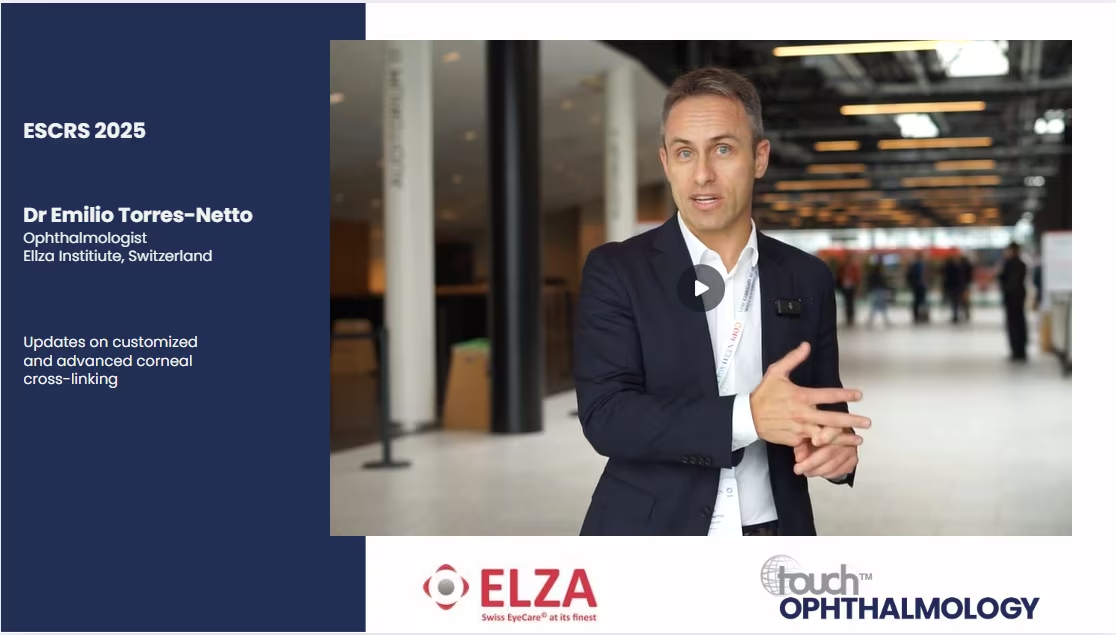
Following his presentations at ESCRS 2025, one of the year’s most important meetings for surgical and refractive innovation, Dr Emilio Torres-Netto shares key updates on ELZA’s next-generation approaches to personalised keratoconus care.
In this Q&A, he discusses ELZA-PACE—the second-generation customised cross-linking technique designed to concentrate treatment precisely where the cornea is weakest—alongside the latest insights from the sub400 protocol for ultra-thin corneas and the role of ECO-CAIRS within a staged, individualised rehabilitation pathway.
Dr Torres-Netto shares the ELZA highlights from ESCRS 2025:
Q: ELZA-PACE has been described as a “second-generation customized cross-linking” technique. How does it differ from first-generation customized CXL and what are the clinical benefits?
ELZA-PACE (Phototherapeutic keratectomy-assisted customized epi-on CXL) represents a second-generation evolution in corneal cross-linking. It uses an epithelial-map-guided PTK to selectively remove the epithelium over the cone while preserving it peripherally. This design establishes three overlapping gradients—of riboflavin concentration, oxygen availability, and UV fluence—that interact to focus cross-linking energy within the biomechanically weakest region of the cornea.
The result is targeted cone flattening and optical regularization without stromal ablation. In our prospective series of 165 eyes with up to 44 months of follow-up, ELZA-PACE reduced corneal asymmetry by up to 15 D and achieved 3–6 D of cone flattening on average, with marked reductions in higher-order aberrations and significant improvement in best-corrected visual acuity. Endothelial cell counts remained stable, confirming safety despite locally increased fluence.
Q: Could you explain how the sub400 protocol adapts CXL for very thin corneas, and what new insights the second-generation version provides?
The ELZA-sub400 protocol individualizes UV fluence according to stromal thickness, allowing safe and effective treatment of corneas as thin as 214 µm. The algorithm calculates the irradiation time required to maintain a ~70 µm un-cross-linked safety margin above the endothelium.
The second-generation sub400 increases total fluence from 5.4 to 10 J/cm² at 400 µm, achieving Dresden-like efficacy in a shorter procedure. One-year data show significant corneal stabilization, no endothelial decompensation, and a trend toward greater flattening with higher fluence. This approach ensures that even ultra-thin corneas—previously ineligible for standard CXL—can now be safely cross-linked.
Q: ECO-CAIRS was also highlighted as part of ELZA’s staged keratoconus rehabilitation. How does this complement customized CXL?
ECO-CAIRS (Extracorporeal Corneal Allogenic Intrastromal Ring Segments) combines biomechanical and optical restoration. Allogenic corneal ring segments are cross-linked extracorporeally at ultra-high fluence before implantation, yielding stiff, transparent implants that reshape the cornea.When performed after stabilization with ELZA-PACE or sub400, ECO-CAIRS provides additional regularization and visual improvement in advanced ectasia. The staged combination of ELZA-PACE, ECO-CAIRS ± total cornea wave-front guided-PRK allows sequential biomechanical strengthening, shape correction, and refractive refinement—an individualized strategy for keratoconus rehabilitation.
Disclosures: Emilio Torres-Netto has nothing to disclose in relation to this article. No fees or funding were associated with this article.
Citation: Emilio Torres-Netto. Keratoconus treatment updates: Insights from Emilio Torres-Netto at ESCRS 2025. touchOPHTHALMOLOGY.com. 26 November 2025.
Learn more about ELZA at ESCRS here.
Register now to receive the touchOPHTHALMOLOGY newsletter!
Don’t miss out on hearing about our latest peer reviewed articles, expert opinions, conference news, podcasts and more.

This content has been developed independently by Touch Medical Media for touchOPHTHALMOLOGY. It is not affiliated with ESCRS. Views expressed are the speaker’s own and do not necessarily reflect the views of Touch Medical Media.