touchOPHTHALMOLOGY coverage from ESCRS 2025
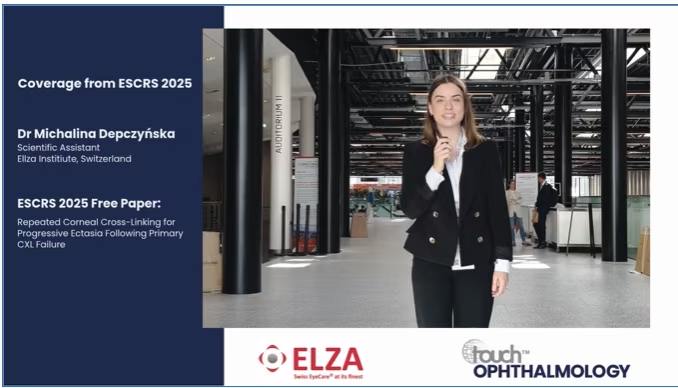
At ESCRS 2025, leading ophthalmologists and researchers gathered to share advances in refractive and cataract surgery, with particular attention on innovations in corneal therapeutics. Among the studies drawing interest this year was new research from the ELZA Institute in Switzerland, presented by Dr Michalina Depczyńska, examining the role of repeated corneal cross-linking (Re-CXL) in eyes showing progressive ectasia after initial treatment failure.
Dr Depczyńska’s study adds valuable evidence to an area of growing clinical relevance—how best to manage the small but significant proportion of patients who continue to show progression despite undergoing standard corneal cross-linking (CXL). We spoke with her during the congress to learn more about the rationale, design, and implications of this work.
Key information
Purpose:
To evaluate the efficacy and safety of repeated corneal cross-linking (Re-CXL) in eyes showing progressive ectasia after primary CXL failure.
Methods:
This retrospective study included 21 eyes (19 keratoconus, 2 post-LASIK ectasia) from 18 patients treated at the ELZA Institute (Dietikon, Switzerland). All eyes underwent individualized epithelium-off CXL with riboflavin soaking and UVA irradiation (mean fluence 10.95 ± 2.3 J/cm²). Corneal tomography (Pentacam HR) was used to assess Kmax, K1, K2, thinnest pachymetry, and anterior radius of curvature (3 mm zone) before treatment, at 6 months, and 1 year.
Results:
Significant reductions in Kmax, K1, and K2 were observed after Re-CXL (p < 0.05), indicating effective corneal stabilization. No cases of endothelial or stromal decompensation occurred. Although correlation analyses did not reach statistical significance, there was a trend suggesting that higher fluence may yield greater keratometric flattening.
Conclusion:
Re-CXL can effectively stabilize progressive ectasia after primary CXL failure while maintaining corneal safety. The trend toward stronger flattening at higher fluence supports further investigation into dose optimization. Despite the study’s retrospective design and small sample size, these findings suggest that Re-CXL may be a valuable option in the management of recurrent ectatic disease.
Disclosures: Michalina Depczyńska has nothing to disclose in relation to this article. No fees or funding were associated with this article.
Citation: Michalina Depczyńska. Evaluating repeated corneal cross-linking (Re-CXL) for progressive ectasia. touchOPHTHALMOLOGY.com. 20 November 2025.
Register now to receive the touchOPHTHALMOLOGY newsletter!
Don’t miss out on hearing about our latest peer reviewed articles, expert opinions, conference news, podcasts and more.