touchOPHTHALMOLOGY coverage from ESCRS 2025
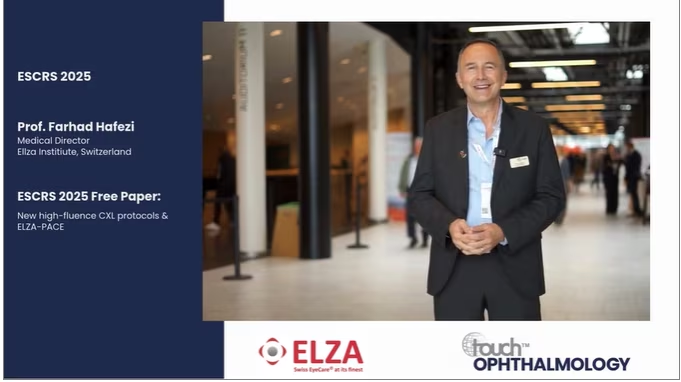
At ESCRS 2025, Prof. Farhad Hafezi presented new data on next-generation corneal cross-linking (CXL) protocols, including high-fluence approaches and the evolving ELZA-PACE platform. His work continues to push the boundaries of what is possible in keratoconus management—expanding treatment options, improving safety in thin corneas, and refining both epi-off and epi-on techniques through optimized oxygen kinetics and fluence control.
Prof. Hafezi shares the ELZA highlights from ESCRS 2025:
Read our Q&A with Prof. Hafezi, as he discusses the clinical evidence behind high-fluence CXL, the latest insights into ELZA-sub400 for ultra-thin corneas, and what these developments mean for the future of personalized CXL care.
Q: What is “high-fluence” CXL and what clinical evidence supports it (epi-off vs. optimized epi-on)?
“High-fluence” denotes UVA delivery above classic Dresden fluence of 5.4 J/cm², coupled with optimized delivery (pulsing, penetration enhancers) to improve oxygen kinetics and biomechanical effect. Clinically, two strands of evidence are relevant:
- Accelerated high-fluence epi-off CXL (18 mW/cm² × 9:15; C-eye; RIBO-ker): In a 1-year series (42 eyes), the demarcation line (DL) averaged 257 µm; thinnest corneal thickness and epithelial thickness showed no significant change; and ECD remained stable (Δ 4.17 cells/mm²; p = 0.87). These outcomes support a Dresden-like biomechanical effect with shorter treatment time.1 (and Aydemir, submitted)
- Optimized high-fluence ELZA-epi-on CXL (pulsed 18 mW/cm²; second-generation enhancer; no supplemental O₂/iontophoresis): At 12 months, keratometric and pachymetric parameters were stable (e.g., Kmax 56.12→56.11 D; p = 0.99). DL depth ~225 ± 34 µm confirms effective stromal impact, and no significant ECD loss was observed (p = 0.87). This protocol achieved stabilization with intact epithelium and improved comfort.2 (and Hafezi, submitted)
Together, these data indicate that both epi-off (accelerated high-fluence) and optimized epi-on protocols can deliver robust stabilization with reassuring safety signals at 1 year, when delivered with appropriate kinetics and dosing.
Q: How safe is the ELZA-sub400 CXL in thin corneas, and what does the second-generation protocol change?
The ELZA-sub400 concept individualizes fluence to stromal thickness to preserve an endothelial safety margin in corneas <400 µm of stroma. The second-generation version raises the reference fluence at 400 µm from 5.4 to 10 J/cm² while shortening total treatment time; intensity is 9 mW/cm² (≥330–400 µm) or 3 mW/cm² (<330 µm), with duration adapted by the published algorithm. The one-year data presented that we presented at ESCRS show no endothelial decompensation, no significant changes in CDVA, sphere, or cylinder, and expected tomographic behavior; ARC3 mm increased modestly (0.69 ± 0.40 mm; p = 0.048).3
Critically, a 2025 study (1) of 17 thin-cornea eyes (median stromal thickness 357 µm, range 210–388 µm) undergoing ELZA-sub400 cross-linking reported no clinical endothelial decompensation; the DL-to-endothelium distance was 80 µm (IQR 45–91; range 21–174), and the mean ECD change was +56 cells/mm² (95% CI −9.6 to +122.4; p = 0.09), i.e., not significant. These findings support the endothelial safety of sub400 in appropriately selected ultra-thin corneas. (J Refract Surg. 2025;41(7):e682–e689; PMID 40626429).4
Q: What are the practical implications for clinicians and for future consensus/guidelines?
Three points:
- Protocol selection by phenotype and thickness. For aggressive/progressive ectasia, accelerated high-fluence epi-off with optimized delivery can provide Dresden-like strengthening in less time, with stable ECD and DL ≈ 257 µm at 1 year.
- Epi-on viability when designed correctly. When oxygen kinetics and riboflavin penetration are engineered (pulsed high-fluence, second-gen enhancer), epi-on CXL can stabilize ectasia at 12 months with DL ≈ 225 µm and no ECD loss, offering a patient-friendly option.
- Ultra-thin corneas are no longer excluded. Second-generation ELZA-sub400 extends safe treatment to very thin corneas using thickness-adapted fluence; the JRS 2025 ECD data strengthen the safety case.
These strands are converging toward personalized CXL: match fluence/intensity/duration to thickness and phenotype, and consider optimized epi-on where epithelial integrity is advantageous (e.g., risk of epithelial closure problems). As consensus evolves, we anticipate clearer decision algorithms integrating high-fluence epi-off, ELZA epi-on, and ELZA-sub400 based on safety margins (DL-to-endothelium) and objective stability metrics.
References:
- Abrishamchi R, Abdshahzadeh H, Hillen M, Hafezi N, Torres-Netto EA, Aslanides IM, Chen S, Randleman JB, Hafezi F. High-Fluence Accelerated Epithelium-Off Corneal Cross-Linking Protocol Provides Dresden Protocol-Like Corneal Strengthening. Transl Vis Sci Technol. 2021;10:10.
- Lu NJ, Torres-Netto EA, Aydemir ME, Kling S, Hafezi N, Kollros L, Hafezi F. A Transepithelial Corneal Cross-linking (CXL) Protocol Providing the Same Biomechanical Strengthening as Accelerated Epithelium-off CXL. J Refract Surg. 2025;41:e724–e30.
- Hafezi F, Kling S, Gilardoni F, Hafezi N, Hillen M, Abrishamchi R, Gomes JAP, Mazzotta C, Randleman JB, Torres-Netto EA. Individualized Corneal Cross-linking With Riboflavin and UV-A in Ultrathin Corneas: The Sub400 Protocol. Am J Ophthalmol. 2021;224:133–42.
- Blaser F, Torres-Netto EA, Gatzioufas Z, Perschak P, Hafezi F, Said S. Assessing Endothelial Integrity in Patients With Progressive Keratoconus and Thin Corneas Treated With the Sub400 Corneal Cross-linking Protocol. J Refract Surg. 2025;41:e682-e89.
Disclosures: Farhad Hafezi has nothing to disclose in relation to this article. No fees or funding were associated with this article.
Citation: Farhad Hafezi. Progress in corneal cross-linking: Insights from Prof. Farhad Hafezi at ESCRS 2025. touchOPHTHALMOLOGY.com. 18 November 2025.
Learn more about ELZA at ESCRS here.
Register now to receive the touchOPHTHALMOLOGY newsletter!
Don’t miss out on hearing about our latest peer reviewed articles, expert opinions, conference news, podcasts and more.

This content has been developed independently by Touch Medical Media for touchOPHTHALMOLOGY. It is not affiliated with ESCRS. Views expressed are the speaker’s own and do not necessarily reflect the views of Touch Medical Media.