Posterior Segment

As we prepare for the launch of touchOPHTHALMOLOGY Future Leaders 2026, one theme has consistently emerged: future leaders do not develop in isolation. Behind every confident clinician, thoughtful academic and emerging opinion leader stands at least one mentor who has helped shaped their direction, discipline and mindset.

touchOPHTHALMOLOGY Future Leaders 2026 is nearly here! We are counting down to the launch of touchOPHTHALMOLOGY Future Leaders 2026 – a celebration of the rising stars shaping the future of ophthalmology.

As 2026 gets underway, January has delivered a busy start across regulation, clinical research and community awareness. Here are some of the top news and research stories from the month.

Initial results from the Phase 1 GARDian1 trial of OCU410ST, recently published in Eye, report early safety and exploratory efficacy findings in adults with Stargardt disease (STGD1).
Specializing in ophthalmology is an exciting milestone – but it can also feel overwhelming. The transition from training to independent practice comes with big decisions, new responsibilities and the pressure to build a career that will stand the test of time. We asked members of our faculty and Future Leaders what guidance they would offer to colleagues just beginning their careers.

In this episode, Nicky speaks with Prof. Georgina Ellison-Hughes from King’s College London about the groundbreaking field of senolytics and their potential to advance the treatment of age-related diseases. From understanding the science behind cellular senescence to how senolytic drugs work and what early clinical trials reveal, this episode explores an exciting frontier in longevity medicine.

Artificial intelligence (AI) is becoming an increasingly important cornerstone of innovation in ophthalmology. From diagnostics and treatment planning to practice management and clinical research, its potential to impact patient care is immense. We asked five leading experts in the field what excites them most about AI in their daily practice and future applications.
In this Voices in vision Q&A, Dr Arrigo discusses the current clinical challenges facing retinal specialists, the developments that have shaped practice over the past year, and how artificial intelligence could transform diagnosis and patient management in the years ahead.
At EURETINA 2025 in Paris, Dr David Eichenbaum presented late-breaking data on the use of structural biomarkers to predict exudative AMD in geographic atrophy (GA). Using real-world datasets and AI-powered analysis via the EvidenceEngine platform, his research demonstrates how multimodal imaging and validated biomarkers can deliver rapid, scalable insights into disease progression. In this Q&A, Dr Eichenbaum shares his perspectives on: How AI-based approaches compare with traditional clinical trial methods The key biomarkers linked to increased exudation risk in GA The potential for AI-driven biomarker research to transform retinal disease management and future clinical research

With the second half of 2025 underway, we asked our touchOPHTHALMOLOGY Future Leaders 2025 to share the developments they believe will shape the future of the field. Here, they highlight four exciting areas that look set to change practice - not only as the year draws to a close, but well into the future.

Physician burnout is at a critical point. In this episode, Nicky speaks with Dr Alfred Atanda about why so many physicians are burning out and what can be done to change the trend. From personal experience to system-wide solutions, Dr Atanda shares valuable insights on improving physician well-being and building a more effective healthcare culture.

What if your medical degree could launch more than a clinical career? In this candid and compelling read, Dr Jon Edelson shares his lessons for early-career clinicians ready to think beyond the bedside and explore the business of medicine.
Taking place from 7–9 June 2025 in Lisbon, Portugal, the SOE Congress is one of Europe's leading multi-specialty ophthalmology meetings. With a world-class scientific programme, this in-person event offers a rich mix of symposia, live surgery, debates, workshops, mystery cases and updates ...

In this episode, we explore the future of continuing medical education (CME) with the team behind touchIME. Hannah Fisher and Matthew Goodwin share insights into global and US trends, the importance of patient inclusivity and how educational outcomes are evolving to better measure the direct impact of learning on clinical practice and patient care.
This episode explores the inspiring work of Orbis International, a nonprofit preventing blindness and restoring sight in underserved communities. Dr Maria Berrocal, Associate Professor and Orbis Volunteer Faculty, shares her experience aboard the Orbis Flying Eye Hospital, a fully equipped surgical and teaching hospital on an aircraft, and discusses the importance of global collaboration in building sustainable, high-quality eye care systems around the world.
This year, we are celebrating our inaugural touchOPHTHALMOLOGY Future Leaders to recognize the outstanding talent that has entered our field in recent years. These individuals are set to innovate and transform ophthalmology in the years to come.
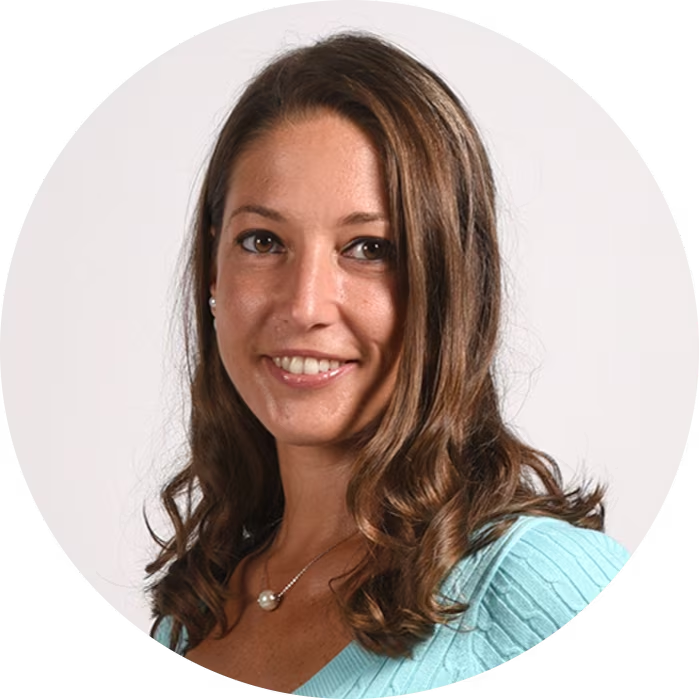
In this Q&A, Dr Cicinelli shares her inspirations, career journey and insights into the future of ophthalmology and where she plans to make her mark.
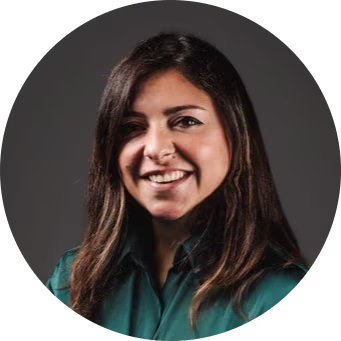
In this Q&A, she shares insights into her career journey, the latest innovations shaping the field and her vision for the future of ophthalmology.
Log into your Touch Account
Keep track of your clinical interests and newsletter subscriptions.
Sign up with an Email
Or use a .
Register now for FREE access
Already registered? Login below.
