

US OPHTHALMIC REVIEW – VOLUME 8 ISSUE 2 – FALL 2015
Welcome to the Fall edition of US Ophthalmic Review. This edition features a wide range of timely and concise review articles on some of the most important topics in the field including corneal disorders, glaucoma, diabetic macular edema (DME), retinopathy and macular degeneration. Farid et al review surgical techniques for posterior chamber intraocular lens fixation in the absence of capsular lens support and Loewen et al discuss the latest data on patient selection, preparation, technique, management, and outcomes with the Trabectome. In our Retina section Dugel et al discuss new approaches to DME with ILUVIEN and Moshfeghi et al explore wide-field imaging of retinal diseases. Supplementary video content for a selection of these articles can be viewed in our Media Gallery.We hope you enjoy this collection of topical articles, and that they provide useful information relevant to your practice and interests.
Foreword
In the realm of cataract surgery, technologic advances allowing perfect refractive outcomes are becoming the norm. There is a growing body of literature to show that the benefits of laser cataract refractive surgery have major implications for a range of parameters, including the accuracy of refractive surgical outcomes, incidence and spectrum of intraoperative complications, and […]
Cornea
An ongoing challenge in complex anterior segment surgery continues to be the safe and effective management of long-term intraocular lens (IOL) fixation in the absence of capsular support. Although anterior chamber IOLs are still an option, especially with improved lens designs and relative ease in placement, complications can still occur including corneal decompensation, iris chaffing, […]

With the increasing use of advanced technology intraocular lenses (ATIOLs), the need for careful preoperative assessment is critical for both determination of a patient’s candidacy for an ATIOL and the identification of patients who are not appropriate candidates.1 Currently, topography is not considered part of the official standard preoperative workup for cataract surgery patients and […]
Glaucoma
Thirty-nine million people in 2012 could not see the external world at all. Two hundred and forty-six million people saw the world poorly. Many of these people lose the ability to function and consequently have a decreased quality of life. Much of that decreased ability to function, along with the attendant worsening of quality of […]

Glaucoma is a leading cause of blindness worldwide.1 Broadly speaking, there are two types of glaucoma: open angle and angle closure. Unlike open angle where the angle between the iris and cornea is open, angle closure glaucoma is an optic neuropathy secondary to raised intraocular pressure (IOP) due to the closure of the drainage angle. […]

Ab interno trabeculectomy with the Trabectome® (NeoMedix , Tustin, CA, US) is a minimally invasive glaucoma surgery (MIGS) modality that increases conventional outflow over 6 clock hours through a single incision.1 The tip of the Trabectome handpiece generates plasma that ionizes and ablates the trabecular meshwork (TM), a mechanism that is fundamentally different from cautery. […]
Retina

Currently four pharmacotherapies have been approved in the US for the treatment of diabetic macular edema (DME)—the antivascular endothelial growth factor (VEGF) therapies ranibizumab (Lucentis®), a binding fragment, and aflibercept (EYLEA®), a fusion protein, and the intraocular corticosteroids dexamethasone (Ozurdex®) and fluocinolone acetonide (ILUVIEN®). Although having four approved treatment options provides a choice for managing […]
End-stage AMD—Clinical Challenge withNew Option for Visual Rehabilitation Age-related macular degeneration (AMD) is a leading cause of vision loss with approximately 200,000 new diagnoses of its neovascular form each year in the US alone.1 Fortunately, many of these patients benefit from antivascular endothelial growth factor (anti-VEGF) pharmaceutical treatments, and such management has changed the epidemiology […]

In 2006, the US Food and Drug Administration (FDA) approved Genentech’s ranibizumab (Lucentis®), a Fab fragment of a humanized monoclonal antivascular endothelial growth factor (VEGF)-A designed for intraocular use for the treatment of exudative age-related macular degeneration (ARMD). Since 2006, ranibizumab and its parent monoclonal antibody bevacizumab have been extensively used to treat exudative ARMD. […]

Retinal imaging serves as a critical adjunct to the diagnosis, monitoring, and treatment of numerous ocular diseases. Since the invention of the direct ophthalmoscope by Hermann von Helmholtz in 1851, techniques to visualize the fundus have grown exponentially both in number and sophistication. Notably, wide-field retinal imaging has taken center stage over the past 2 […]

A 55-year-old woman presented to us for her initial visit with blurry vision for 1 month. She denied any prior ocular history, including diabetic retinopathy. Medical history was significant for diabetes mellitus, hypertension, renal cell carcinoma, and recently resected metastatic malignant melanoma (pT4bN1b, Stage IIIC). Following resection, she was started on high-dose pegylated interferon alpha-2b […]
Trauma and Surgery
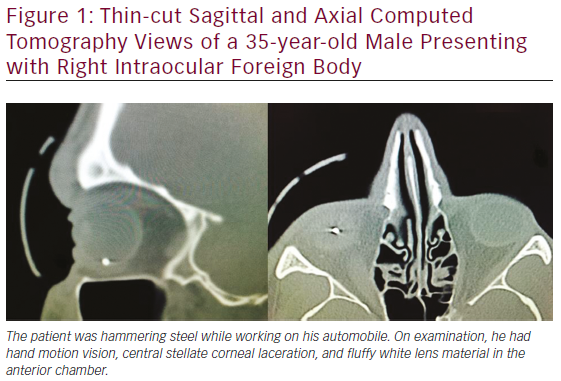
In the US, approximately 3 % of all emergency department visits are related to eye trauma.1 Many of these cases unfortunately lead to permanent visual impairment as ocular injury accounts for the leading cause of irreversible vision loss in teenagers and young adults.2,3 When penetrating or openglobe injuries occur, an estimated 10 to 41 % […]

Case Report A healthy 25-year-old female patient, with a 6-month history, reported with a chief complaint of left upper lid mass and droopiness. History revealed that the swelling initially started as a peanut size and had gradually increased to the present size. Ocular examination was suggestive of nontender, bony hard, noncompressible, nonfluctuant, and nonpulsatile swelling […]

Trending Topic
Corneal ectatic disorders, such as keratoconus, progressively weaken corneal integrity, leading to thinning, irregular astigmatism and visual deterioration.1 Typically progressive in nature, these ectasias result in increasingly thinner corneas, causing the cornea to protrude forward into a cone shape. This leads to increasing amounts of myopia and astigmatism – both regular and irregular – as the disease […]


Log into your Touch Account
Keep track of your clinical interests and newsletter subscriptions.
Sign up with an Email
Or use a .
Register now for FREE access
Already registered? Login below.
