

US OPHTHALMIC REVIEW – VOLUME 11 – ISSUE 1 – SPRING 2018
Welcome to the Spring edition of US Ophthalmic Review, full of topical and practical content for busy ophthalmologists.
This edition opens with a selection of expert interviews covering topical issues raised at the recent AAO meeting on the topics of ocular surface disease and refractive surgery, and the latest technological advances in cataract surgery.
Cataract surgery is also the topic of our two practice pearls, and Marjan Farid and Bryan Lee share their top tricks and tips for managing difficult cases. We’re excited to share more practice pearls in our Fall edition later this year.
We cover a range of areas in our review and research sections. Our fantastic Editor-in-Chief Elizabeth Yeu explores the role of active fluidics and torsional phaco power in cataract surgery and Sumit Garg shares his clinical experience with the implantable miniature telescope for end-stage age-related macular degeneration.
We hope you enjoy this edition, which will be distributed at the upcoming ASCRS meetings – don’t forget to pick up a free copy from the AAO booth.
We are now accepting submission to our Fall edition, and welcome you to submit you manuscript here.
Enjoy!
Foreword
Welcome to the latest edition of US Ophthalmic Review, which features a wide range of articles that have been chosen for their assessment of current practices and research that directly affect ophthalmologists and other practitioners involved in the care of patients with ophthalmic disease. Our expert interviews have become a popular feature of the journal, […]
Expert interview
Cynthia Matossian, MD, FACS, is the founder and Medical Director of Matossian Eye Associates, an integrated ophthalmology and optometry private practice with locations in New Jersey and Pennsylvania. She specializes in refractive cataract surgery and ocular surface disease. In November, she was presented with the Ophthalmic World Leaders (OWL) Visionary Award in recognition of […]
The ophthalmic community has recently celebrated 50 years of phacoemulsification innovation, and the technology continues to evolve. Recent advances in phacoemulsification techniques and technology have improved surgical outcomes and reduced complications pre and post cataract surgery. However, opinions vary as to which techniques offer the best outcome. In an expert interview, Jennifer Loh, a board-certified […]
Refractive lens exchange (RLE) is frequently used as a refractive surgical procedure for the correction of high presbyopia and high hyperopia, for which laser-assisted in situ keratomileusis (LASIK), photorefractive keratectomy (PRK) or phakic intraocular lens (IOL) refractive surgery is unsuitable. In an expert interview, Deepinder K Dhaliwal, Professor of Ophthalmology at the University of Pittsburgh […]
Inflammatory ocular diseases cover a wide spectrum of conditions and are a growing public health concern. Dry eye disease is one of the most common conditions seen by eye care practitioners. Allergic conjunctivitis is also a highly prevalent condition, especially during hay fever season. In addition to these well characterized disorders, less-common inflammatory conditions such […]
Editorial
What started my research in genetic mutations in cows leading to different types of milk was my interest and research in chronic diseases, possibly caused by or related to genetic chromosomal mutations. My first involvement in this type of research was in 1965–1967, when I was researching my textbook Ophthalmic Eponyms: An Encyclopedia of Named […]
Practice Pearl
The key to a successful white cataract surgery is to be prepared. This starts with a thorough preoperative evaluation. A careful slit lamp exam is important—if the anterior lens is bulging, this could be a sign of increased posterior intralenticular pressure. Does the cortex look formed or milky? Can you see a brunescent nuclear center? […]

Small pupils present a significant challenge for the cataract surgeon, requiring excellent intraoperative decision making to maximize the likelihood of a successful outcome. One of the common causes of small pupils, intraoperative floppy iris syndrome (IFIS), in particular increases the likelihood of complications such as posterior capsule rupture and iris trauma. Fortunately, a variety of […]
Reviews

Phacoemulsification is the gold standard for cataract surgery,1 and for good reason—over the decades it has been shown to be a safe and efficacious procedure that returns excellent visual outcomes to patients with cataracts. Every phacoemulsification system on the market can provide patients with excellent postoperative vision, with very low complication rates, however, they do […]
Trabeculectomy and tube shunt surgeries have an important role in glaucoma management, offering the ability to achieve intraocular pressure (IOP) lowering independent of patients’ compliance in appropriate candidates. Both trabeculectomy and tube shunt drainage devices, performed using an ab externo approach, achieve lowering of IOP via drainage of aqueous from the anterior chamber (AC) to […]
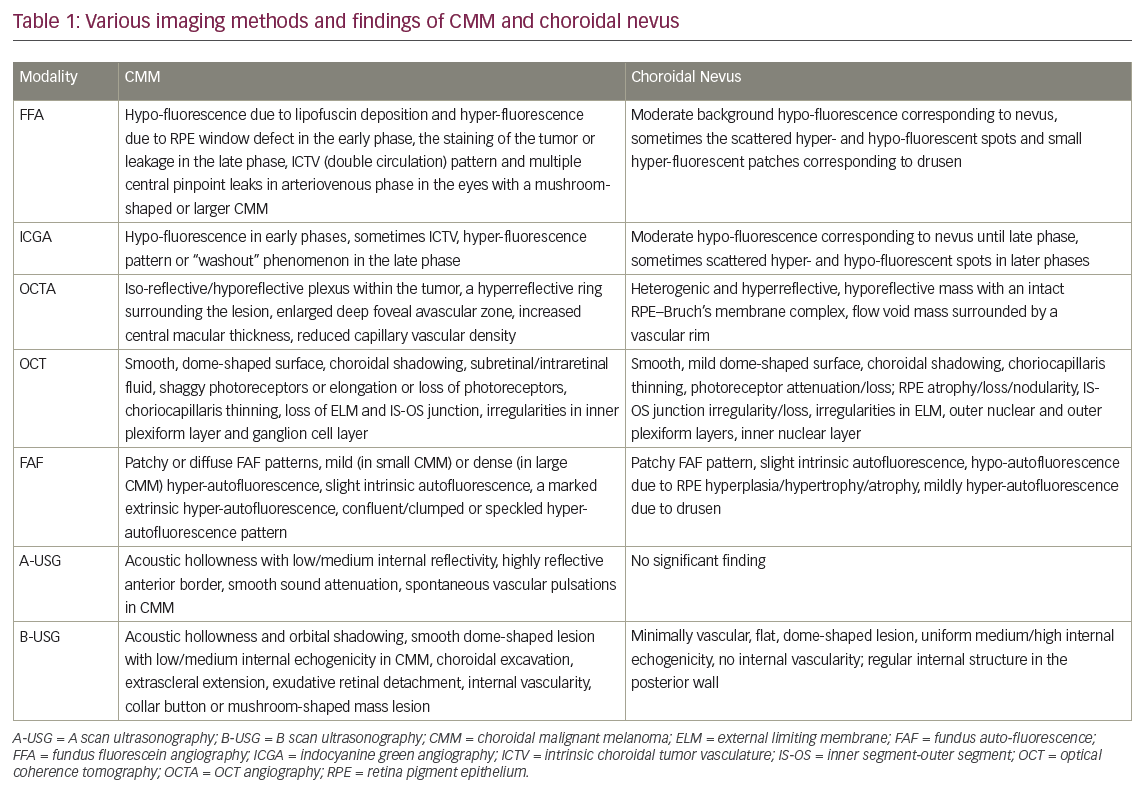
Choroidal malignant melanoma (CMM) is the most common primary malignant intraocular tumor in adults. Significant risk factors for CMM include eyes with light-colored irises, such as green, blue, or gray; fair skin, cutaneous nevus and iris nevus, Caucasian ethnicity, and chronic sunlight exposure. CMMs often have: undefined boundaries; sharp elevation of the edges; an irregular, […]

Advanced age-related macular degeneration (AMD) is often bilateral and most prevalent in patients over age 60.1,2 AMD is considered end-stage when visual impairment resulting from bilateral central scotomas and/or disciform scars is moderate to profound. Treatment options for patients with end-stage AMD are extremely limited. As a result, patients with end-stage AMD have a severely […]
Case Report

Keratoconus is an ectatic corneal disorder characterized by a change in the organization and structure of the cornea. It is usually progressive and bilateral but asymmetrical. Keratoconus usually manifests during adolescence and early adulthood.1 Riboflavin-ultraviolet-A (UVA) cross-linking (CXL) is a technique introduced in the past decade for the treatment of progressive keratectasia and keratoconus.2 Several […]

Trending Topic
Corneal ectatic disorders, such as keratoconus, progressively weaken corneal integrity, leading to thinning, irregular astigmatism and visual deterioration.1 Typically progressive in nature, these ectasias result in increasingly thinner corneas, causing the cornea to protrude forward into a cone shape. This leads to increasing amounts of myopia and astigmatism – both regular and irregular – as the disease […]


Log into your Touch Account
Keep track of your clinical interests and newsletter subscriptions.
Sign up with an Email
Or use a .
Register now for FREE access
Already registered? Login below.
