

US OPHTHALMIC REVIEW – VOLUME 13 – ISSUE 1 – SPRING 2020
Welcome to the spring edition of US Ophthalmic Review, which includes a range of editorial, commentary, review and case report articles on a variety of insightful topics within the ophthalmology landscape including cornea, photosensitivity, glaucoma, neuro-ophthalmology, and ocular oncology.
We are welcoming submissions to our Fall 2020 edition. If you are interested, you can submit a manuscript here.
Foreword

I am delighted to welcome you to the Spring 2020 edition of US Ophthalmic Review. This edition features some wide-ranging and insightful articles from top names in ophthalmology from around the globe. We begin with an insightful Expert Interview with Deborah K VanderVeen, from Boston Children’s Hospital, about the rationale for the use of orthokeratology for the […]
Expert Interview

In this Expert Interview, we speak to Dr Deborah K VanderVeen about the rationale for the use of orthokeratology for the prevention of myopic progression in children, and the conclusion of the recent American Academy of Ophthalmology (AAO) report on this subject. She also discusses which children it would likely benefit and those in whom […]
Practice Pearl

Brunescent, or brown, cataracts are found in advanced cataracts and can cause decreased visual acuity, with poor contrast and color discrimination, especially at the blue end of the visible light spectrum.1 They are particularly challenging to treat due to the increased nuclear density, and surgery is associated with a higher rate of complications compared with other […]
Commentary
I was interested to read the review, “Optical Lens Tinting—A Review of its Functional Mechanism, Efficacy, and Applications” by Jared Raabe, Ashwini Kini, and Andrew Lee, which appeared in US Ophthalmic Review.1 I am the inventor of the FL–41 lens that features in the article. As the authors point out, the original design of the lens […]
Reviews

Cataract is the leading cause of blindness worldwide and accounts for half of all visual impairment in the USA.1 Contributing risk factors are older age, smoking, alcohol use, sunlight exposure, and diabetes.1 Cataract affects more than 24 million Americans; that number is expected to reach 50 million by the year 2050.1 More than 3.6 million cataract surgeries are […]

Recently, new surgical modalities for management of primary angle-closure disease (PACD) have been proposed; the most controversial of which being clear lens extraction (CLE). The Effectiveness in Angle-closure Glaucoma of Lens Extraction (EAGLE) and other studies recommend CLE as the primary procedure of choice to manage eyes with PACD.1–5 However, the rationale for CLE without resorting […]

As the percentage of elderly people that make up the population of the USA grows, it is imperative to shift our focus on how to best address their needs and outline an approach to the geriatric eye. This review describes common physiologic and pathologic conditions affecting the aging eye including presbyopia, posterior cortical atrophy, giant […]
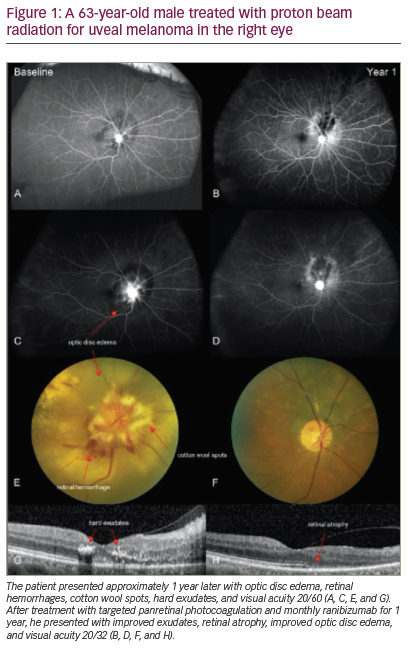
Radiation retinopathy is a common and slowly progressive visual side effect of radiation therapy, such as brachytherapy, external beam radiotherapy, proton beam radiation, helium ion radiotherapy, and gamma knife radiotherapy for uveal melanoma and other intraocular or orbital cancers.1–6 Patients treated with radiation therapy for cancers of the head and neck can also develop radiation-related […]
Case Report

Proparacaine is a topical anesthetic widely used in ophthalmic practice. Proparacaine is well tolerated with limited duration of use, but has potential to become a drug of abuse.1 Extended use has numerous corneal sequelae including stromal infiltrates, corneal melt, and endothelial cell loss.1–3 In this report we present a case of proparacaine-associated keratopathy that necessitated bilateral penetrating […]
Trending Topic
Corneal ectatic disorders, such as keratoconus, progressively weaken corneal integrity, leading to thinning, irregular astigmatism and visual deterioration.1 Typically progressive in nature, these ectasias result in increasingly thinner corneas, causing the cornea to protrude forward into a cone shape. This leads to increasing amounts of myopia and astigmatism – both regular and irregular – as the disease […]


Log into your Touch Account
Keep track of your clinical interests and newsletter subscriptions.
Sign up with an Email
Or use a .
Register now for FREE access
Already registered? Login below.
