What does the evidence say about some of ophthalmology’s most enduring myths?
A new review published in touchREVIEWS in Ophthalmology examines the evidence behind several long-standing beliefs in cataract, glaucoma, retina, and pediatric ophthalmology, highlighting where emerging research is reshaping clinical thinking.
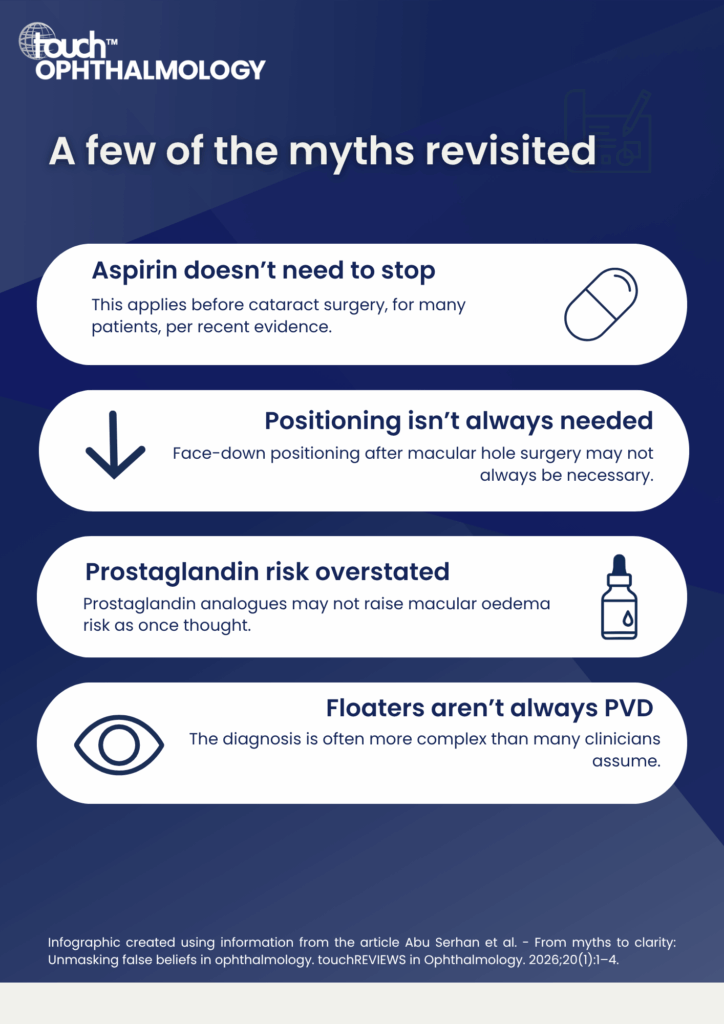
Drawing on studies across retina, glaucoma, cataract, and pediatric ophthalmology, Abu Serhan, Ahmed and Parolini revisit myths that continue to influence everyday practice despite an evolving evidence base. While some of these beliefs originated from earlier studies or expert opinion, the authors argue that more recent research has challenged several widely accepted practices.
The review also highlights an important point: changing clinical practice can take time. Even when robust evidence becomes available, established teaching and habitual practice often persist long after the original rationale has been superseded.
Rather than advocating immediate changes in practice, the authors encourage clinicians to critically re-evaluate long-held assumptions in light of contemporary evidence. They also acknowledge that the strength of evidence varies between topics, with some myths supported by extensive clinical data and others representing areas where further research may continue to refine clinical decision-making.
Discover the evidence behind the myths
These are just a few of the misconceptions explored by Abu Serhan, Ahmed and Parolini. The full review examines the evidence supporting each conclusion and discusses additional topics, including prostaglandin analogue use in uveitis, pediatric cycloplegia, laser peripheral iridotomy placement, pregnancy-associated myopia and mannitol use in vitrectomized eyes.
Want to know what the evidence really says?
→ Read the full review now: From myths to clarity: Unmasking false beliefs in ophthalmology.
Cite: New review challenges long-held myths in ophthalmology. touchOPHTHALMOLOGY. July 10, 2026.
Disclosure: This article was created by the touchOPHTHALMOLOGY team utilizing AI as an editorial tool (Claude [Sonnet 5]. https://claude.ai.) The content was developed and edited by human editors. No funding was received in the publication of this article.
Editor: Nicola Cartridge, Director of Content