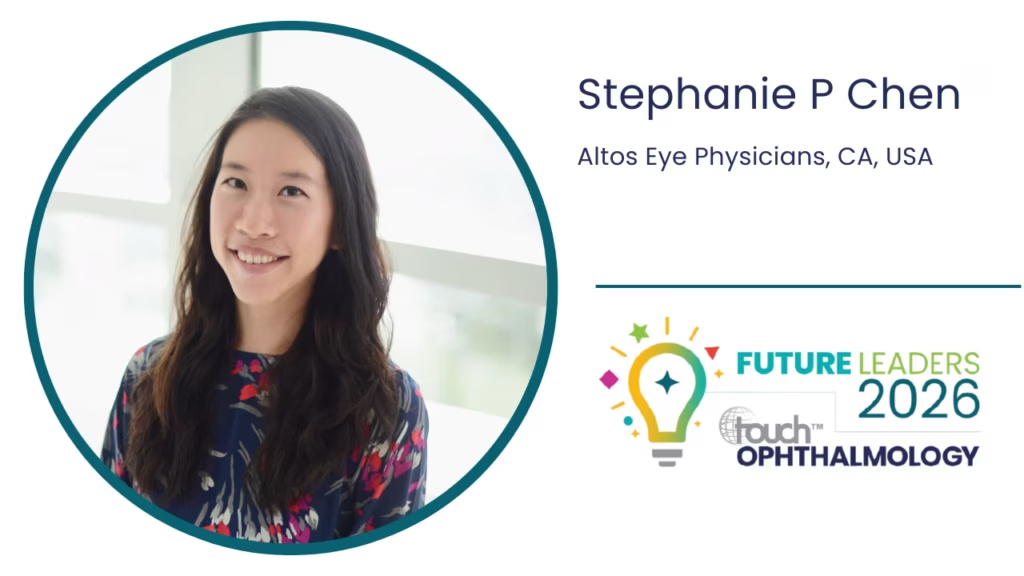
 We are delighted to welcome Dr Stephanie P Chen as a touchOPHTHALMOLOGY Future Leader 2026.
Dr Chen is a board-certified, fellowship-trained ophthalmologist specialising in cataract surgery, cornea transplantation and refractive surgery at Altos Eye Physicians, and serves as Assistant Professor of Ophthalmology at the University of California and Staff Ophthalmologist at the San Francisco Veterans Affairs Healthcare System. A graduate of MIT and Stanford, she completed her residency at UCSF and cornea and refractive fellowship at Bascom Palmer Eye Institute. Her practice focuses on premium cataract surgery, corneal transplantation and complex anterior segment reconstruction, delivered with meticulous technique and highly individualised care.
Dr Chen is also developing a growing profile in sustainable ophthalmology through her role on the EyeSustain Editorial Board, where she advocates for environmentally responsible practice and system-level change in eye care.
In this Q&A, Dr Chen discusses what drew her to ophthalmology, the mentors who shaped her surgical and academic path, and the innovations in lens technology and corneal surgery that most excite her.
Q: What inspired you to pursue a career in ophthalmology?
Growing up in a family of high myopes, myself included, vision care was a constant presence in my early life. At age seven, I transitioned to rigid gas permeable lenses, a process that was both challenging and liberating after years of dependence on glasses. That experience impressed on me, at a young age, the profound impact vision has on quality of life and how meaningful its restoration can be, long before I understood ophthalmology as a specialty.
More than fifteen years later in medical school, I was particularly struck by the residents and attendings I worked with during my ophthalmology rotations. Beyond the technical precision of clinical and surgical care in ophthalmology, I felt a sense of resonance and belonging within the community that was missing from other rotations. I remember thinking, these are the people I want to become and work alongside. They were innovative, intellectually rigorous, and genuinely enjoyed what they did. The fulfilment and satisfaction that comes from restoring sight was evident at every stage of training, and it remains just as powerful and rewarding in my practice today.
Q: Who has been the most significant mentor or role model for you, and what did you learn from them?
The most significant mentor in my career has been David F Chang, MD. He first influenced me during residency through his lectures on phaco chop, where I was drawn to the clarity and precision of his surgical teaching. That mentorship deepened when he hired me as an associate after fellowship, giving me the opportunity to learn first-hand technical nuances perfected after decades of experience from one of the most respected cataract surgeons in the field. Residency and fellowship often focuses on mastering the steps of surgery, but Dr Chang has helped me realize that in many ways, cataract surgery is the easy part. The greater challenge lies in figuring out how to educate patients about complex optical concepts in lay terms, set appropriate expectations, and manage difficult situations with confidence and grace. These “soft skills” are what I now believe distinguish a great surgeon from a truly exceptional ophthalmologist.
Beyond surgical technique, Dr Chang has been a powerful role model through his enduring commitment to education and to advancing the profession by investing in future generations of ophthalmologists. Having personally benefited from the generosity of his time and knowledge, I have been inspired to give back in the same spirit by staffing UCSF residents at the San Francisco VA through the various stages of their cataract surgery training, in addition to maintaining my own practice.

Peer perspective
“Dr Chen is emerging as a leading voice in sustainability within ophthalmology. Through clinical research and publications, the ASCRS sustainability committee, and her editorial work at EyeSustain, she is a leading example of the important role that early career ophthalmologists can play in this emerging international domain”.
Dr David F Chang, University of California, San Francisco, CA, USA
Q: What current innovations in ophthalmology excite you the most?
While much of the current excitement in ophthalmology centers on artificial intelligence and its potential to enhance diagnostics and efficiency, I am particularly focused on the growing movement toward sustainability in eye care. Advanced, complex technologies like robotic surgery are certainly impressive and necessary, but rethinking how we deliver care in a more environmentally responsible way may prove even more consequential for the long-term future of the field. Ophthalmology has emerged as a leader in sustainable healthcare delivery, with initiatives such as EyeSustain championing practical changes to reduce surgical waste, including multiuse phaco systems and reusable instruments. Notably, this represents a unifying commitment among ophthalmic societies worldwide to advance more environmentally friendly practices in our field.
Looking further ahead, I will be keeping a close eye on the development of a truly accommodative intraocular lens, the long-standing “holy grail” of presbyopia correction. A lens that restores physiologic accommodation without optical trade-offs would fundamentally transform cataract and refractive surgery, delivering a level of visual function and quality of life that current presbyopia-correcting IOLs can only approximate.
Disclosures: This short article was prepared by touchOPHTHALMOLOGY in collaboration with Dr Chen. No fees or funding were associated with its publication.
Citation: Dr Stephanie Chen on embedding sustainability in ophthalmic practice: touchOPHTHALMOLOGY Future Leaders 2026. touchOPHTHALMOLOGY. 11 March 2026.
Register now to receive the touchOPHTHALMOLOGY newsletter!
Don’t miss out on hearing about our latest peer reviewed articles, expert opinions, conference news, podcasts and more.