

Don’t miss out on hearing about our latest peer reviewed articles, expert opinions, conference news, podcasts and more.
Dr Eric Rosenberg of SightMD (New York) recently became the first surgeon to perform cataract surgery using Apple Vision Pro. Following an inaugural case in October 2025, Dr Rosenberg and his team have since completed hundreds of procedures using the platform, marking a significant shift in surgical ergonomics.
The workflow utilizes ScopeXR, a surgical interface co-developed by Dr Rosenberg. Designed to integrate seamlessly with existing digital visualization systems, such as Alcon’s Ngenuity 3D, ScopeXR streams real-time stereoscopic microscope imaging directly into the headset. Simultaneously, the platform displays preoperative diagnostics, surgical overlays, and patient-specific data within the surgeon’s expanded field of view.
Notably, the platform is hardware-agnostic, which allows for high-fidelity integration across various surgical microscopes without requiring significant modifications to existing operating room infrastructure. Beyond intraoperative benefits, the system enables real-time remote collaboration; off-site mentors or consultants can view the live surgical field in 3D to provide immediate clinical input.
What could this mean for clinical practice?
Digital heads-up surgery has already improved ergonomics, but mixed reality builds on this by consolidating disparate data streams into a single, unified interface. By removing the reliance on fixed external monitors and facilitating instant, off-site consultation for complex cases, ScopeXR offers a more flexible framework for real-time surgical mentorship and ongoing professional development.
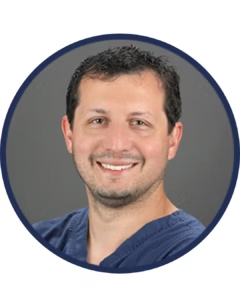 Dr Rosenberg believes the technology could be particularly impactful for training the next generation of ophthalmic surgeons.
“What excites me most about ScopeXR is not just what it does in the operating room today, but what it means for the surgeons of tomorrow. For the first time, a trainee anywhere in the world can be virtually present in a world-class operating room — seeing exactly what the surgeon sees, hearing their decision-making in real time, and accessing the same patient data — without leaving their home institution. ScopeXR means that geography no longer determines the quality of your surgical education or the access you have to expertise when you need it the most. That, to me, is the most profound thing we’ve built — and we’ve only just begun.”
Although still early in adoption, the successful use of Vision Pro in live cataract surgery highlights how immersive computing may soon move beyond proof-of-concept and into everyday ophthalmic practice, supporting not only how surgeons operate, but how they teach, collaborate and learn.
Cite: Could ScopeXR change how cataract surgeons see, teach and collaborate? touchOPHTHALMOLOGY. 20 May 2026.
Editor: Nicola Cartridge, Director of Content
Disclosures: Dr Eric Rosenberg has nothing to disclose in relation to this article.
Acknowledgment: This content has been developed independently by Touch Medical Media for touchOPHTHALMOLOGY. The touchOPHTHALMOLOGY team utilizing AI as an editorial tool (ChatGPT (GPT-5.4) [Large language model]. https://chat.openai.com/chat.) The content was developed and edited by human editors. No funding was received in the publication of this article.