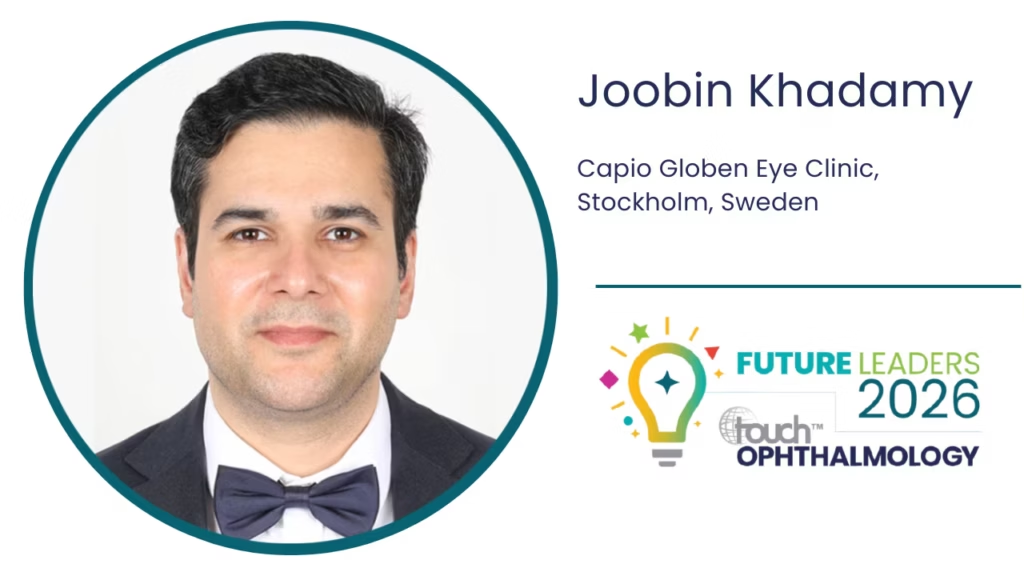
We are delighted to announce Dr Joobin Khadamy as a touchOPHTHALMOLOGY Future Leader 2026, selected by peers as one of the ophthalmologists already shaping the field.
Dr Joobin Khadamy, MD, FEBO, FEBOS-CR, is an accomplished ophthalmologist and cataract surgeon at Capio Globen Eye Clinic, Stockholm, with a strong reputation in clinical practice and research. A Fellow of the European Board of Ophthalmology and one of fewer than 100 surgeons worldwide to hold the prestigious FEBOS-CR diploma awarded by the European Society of Cataract and Refractive Surgeons, he is recognised on the ESCRS FEBOS-CR Wall of Honour for surgical excellence.
Dr Khadamy is also an active academic contributor, serving as a reviewer for international journals and ranking among the top 100 contributors to EyeWiki, with two award-winning articles recognised in international competitions in 2024 and 2025.
In this Future Leaders interview, Dr Khadamy reflects on the mentors that have made an impact on his career so far, the innovations that excite him the most, and his aspirations for the future.
Q: Is there a specific patient, mentor or experience that shaped your path in ophthalmology?
As a child, I was always drawn to engineering. I liked taking things apart, understanding how systems worked, and seeing how very small changes could alter the performance of something much bigger. At the same time, I was fascinated by how the human body heals — how tissue responds after intervention, how structure and biology interact. That combination stayed with me for years.
When I discovered ophthalmology, it felt natural. It brought together everything that interested me: working with my hands, focusing deeply on very small structures, thinking in terms of optics and mechanics — and at the same time witnessing the body’s remarkable capacity to recover. Few specialties demand such precision while also offering such immediate and meaningful impact on a person’s life.
I began my training in Iran in a very academically rigorous environment. Early mentors, including Professor Falavarjani, Parvaresh and others, influenced the way I think about medicine. They encouraged curiosity and disciplined reasoning. I was taught not to accept surface explanations, but to understand disease from its biological foundation before moving toward intervention.
In the operating room, I was fortunate to learn from professors such as Dr Kashkouli, Dr Foroutan, Dr Nilforoushan, Dr Hashemian, Dr Gholam Hossein Aghayee, Dr Pakdel, Dr Sanjari, Dr Asadi, and Dr Masih Hashemi. They guided me step-by-step, not only in technique but in responsibility — how to respect tissue, how to stay calm, how to think during surgery rather than simply perform it. Those lessons shaped my surgical character.
As I grew professionally, I looked beyond borders for inspiration. Surgeons and scientists such as Ike Ahmed, Jorge Alió, Marie-José Tassignon, Farhad Hafezi, Jay Duker, Carol Shields, SriniVas R Sadda, and Gholam Peyman showed that ophthalmology is not just about treating disease — it can create new tools, new devices and new concepts. Their careers expanded my sense of what is possible.
Moving to Sweden was another defining chapter. Rebuilding my career in a public healthcare system forced me to rethink many assumptions. Here, mentors such as Gauti Jóhannesson, Björn Lundberg, Peter Hettinger, Eva Olofsson, and Anders Behndig influenced different parts of my development — surgical standards, academic discipline, and evidence-based thinking.
Working in a publicly funded system changed my clinical mindset. With predominantly elderly patients, decisions are not only about what is technically achievable. They are about what truly matters for that person, in that healthcare system, with available resources. I learned to move from “Can we?” to “Should we?” That shift was humbling and important.
All of these experiences — scientific discipline, surgical mentorship, international transition — shaped how I practice today.

Peer perspective
“Trained outside Europe and experienced in both high-volume and resource-limited settings, he has demonstrated exceptional clinical excellence, including success in the EBO and FEBO CR. Through his award-winning contributions to EyeWiki and his work as a cataract surgeon with a strong interest in retina and research, he exemplifies skill, innovation, and a deep commitment to advancing the field.”
Q: What current innovations in ophthalmology excite you the most?
What excites me most is where imaging, engineering and clinical care intersect.
Ophthalmology is naturally image-driven. Because of that, artificial intelligence (AI) feels like a logical next step. But I think the real challenge is not only developing smarter algorithms — it’s improving how we capture images in the first place. Many of our patients have motion-related disabilities or fixation difficulties, which can make image acquisition inconsistent. Obtaining consistent, high-quality imaging can be difficult. Before AI becomes truly dependable in daily practice, we must improve acquisition systems.
My recent focus has been on anterior segment OCT in uveitis. I am particularly interested in better imaging of the so-called “middle segment,” which remains underexplored. I hope to see the development of contact-lens–assisted OCT systems, three-mirror–like OCT devices, or even spectroscopic OCT that can provide molecular-level information rather than only structure. Moving from purely structural images to functional and biochemical insight could change how we diagnose and monitor inflammatory and neoplastic disease.
Robotic microsurgery is another area I follow closely. Ophthalmic surgery demands extreme precision. Robotics has the potential to reduce tremor, improve reproducibility and enhance safety — especially in delicate procedures. If combined with intelligent planning systems, surgery could become more standardized without losing the surgeon’s judgment and artistry.
I am also interested in device development, particularly refining anterior chamber sampling tools. Better, minimally invasive diagnostics could significantly improve how we identify intraocular tumors, viral keratouveitis or endophthalmitis, leading to more targeted treatment.
At the same time, I believe we must think carefully about how research is directed. Many rare diseases are not economically attractive and therefore receive limited industry support, which can slow progress. Yet studying rare conditions often deepens our understanding of fundamental physiology and generates knowledge that benefits broader fields. On the other hand, commercially successful therapies frequently focus on long-term management rather than prevention or cure. Both are important, but the balance matters.
We also cannot ignore public health. Many eye diseases are influenced by aging, metabolic health, nutrition, and sleep patterns. Lifestyle modification is difficult to implement at a societal level, but prevention remains essential. Innovation should complement — not replace — broader health strategies.
Tissue engineering is another area full of promise. The human lens capsule, for example, may have applications using surgical waste generated during cataract surgery. Biomaterials science and ophthalmology have much more to explore together.
Finally, advances such as whole-eye transplantation and emerging neuroprosthetic interfaces show that boundaries are shifting. These technologies are still evolving, but they offer hope — not only for restoring structure, but perhaps one day for restoring function at a neural level.
Q: What contribution do you hope to make to the future of ophthalmology?
I hope to contribute in three main ways: translating ideas into practice, organizing knowledge and maintaining balance.
First, translation. I want to continue bridging imaging science, device development, and surgical application. Innovation should not remain theoretical. It should become practical — tools that improve diagnosis, reduce complications, and genuinely help patients.
Second, knowledge organization. The volume of ophthalmic research today is overwhelming. No clinician can realistically read everything. I believe we need structured, continuously updated knowledge platforms. Through my work with EyeWiki — where I have been fortunate to contribute extensively — I support the idea of a living ophthalmic encyclopedia. Each disease entity should contain clear, distilled summaries of key studies and meta-analyses, accessible to colleagues worldwide. AI-supported diagnostic tools may also help translate complex evidence into clinical decision-making in a transparent way.
Third, balance. While caring for patients today, we must preserve space for curiosity and research. Clinical workload can easily consume all available time. Yet without continued exploration, innovation stagnates. We need both — responsible patient care and forward-looking investigation.
Ultimately, I hope to contribute to a field that remains scientifically rigorous, technologically open, and socially responsible. For me, ophthalmology will always be the place where engineering meets biology — and where attention to the smallest details can profoundly change a person’s life.
Disclosures: This short article was prepared by touchOPHTHALMOLOGY in collaboration with Dr Khadamy. No fees or funding were associated with its publication.
Citation: Dr Joobin Khadamy on engineering the future of ophthalmic imaging: touchOPHTHALMOLOGY Future Leaders 2026. touchOPHTHALMOLOGY. 11 March 2026.
Register now to receive the touchOPHTHALMOLOGY newsletter!
Don’t miss out on hearing about our latest peer reviewed articles, expert opinions, conference news, podcasts and more.