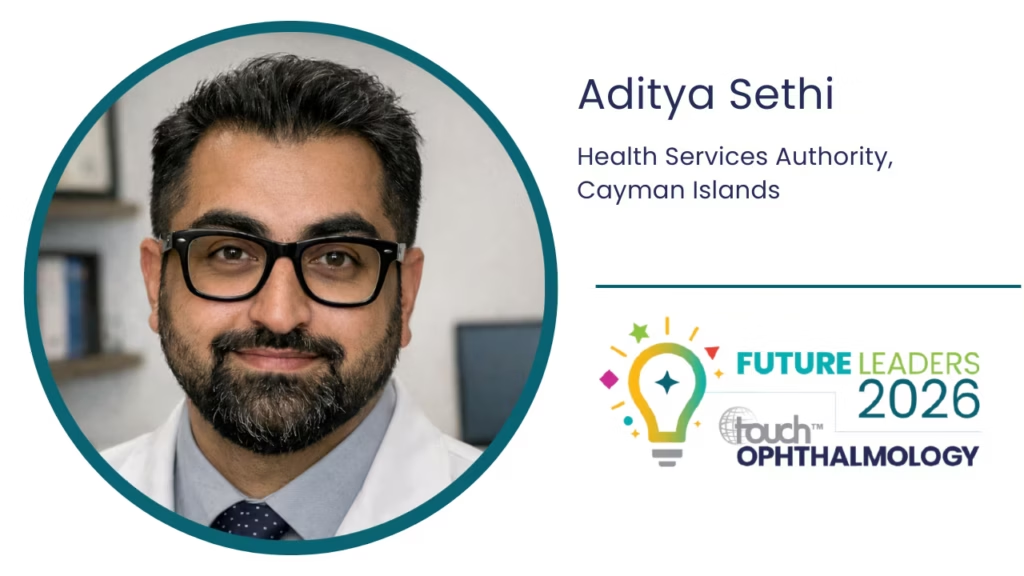
We are delighted to announce Dr Aditya Sethi as a touchOPHTHALMOLOGY Future Leader 2026, selected by his peers as a rising star poised to shape the future of ophthalmology.
Dr Sethi is a Consultant Ophthalmologist at the Health Services Authority in the Cayman Islands, with specialist expertise in cataract, refractive and paediatric ophthalmology. Trained at internationally renowned centres including Sankara Nethralaya in Chennai and the Fyodorov Eye Microsurgery Complex in Moscow, he combines surgical precision with academic rigour and a strong commitment to community-focused eye care. A Fellow of the World College of Refractive Surgery & Visual Sciences, he has received multiple international awards recognising his clinical and academic excellence.
In this Future Leaders interview, Dr Sethi reflects on the early inspirations that drew him to ophthalmology, the mentors who have shaped his approach to practice, and the innovations that most excite him today.
Q: What inspired you to pursue a career in ophthalmology?
My inspiration began very early in life. As a five-year-old, I accompanied my parents to eye camps in rural villages across India. I vividly remember watching them perform cataract surgeries, and more importantly, witnessing the transformation that followed—patients who had been blind regaining vision, dignity, and independence. The gratitude and respect my parents received from patients—often people with very little—left a deep and lasting impression on me.
As I grew older, my involvement deepened. As a teenager, I edited cataract surgery videos, helped my mother prepare and submit films to the ASCRS Film Festival, and attended ophthalmology conferences not as an obligation, but with genuine excitement. Somewhere along the way, I internalised a simple but powerful belief: if you help someone see better, you make their life brighter. That philosophy has stayed with me and continues to guide my work today.
Q: Who has been the most significant mentor or role model for you, and what did you learn from them?
I’ve been extraordinarily fortunate—mentorship has been abundant in my life.
My earliest mentors were at home. My mother, a pioneer of phacoemulsification in India, and my father, widely respected for his humanitarian work and compassion for the underserved, shaped my values long before I entered medical school. Their passion for ophthalmology and community service made this path feel both natural and purposeful.
My formal training at Sankara Nethralaya—often called the Temple of the Eye—was transformative. I had the rare privilege of learning under the late Dr S.S. Badrinath. As a postgraduate, I attended institutional planning and community-service meetings with him, received personal guidance on my academic trajectory, and witnessed firsthand how vision, leadership, and ethics shape institutions. Another towering influence was Dr Meenakshi Swaminathan—an exceptional teacher whose clarity, discipline, and intellectual rigor ignited my interest in paediatric ophthalmology and strabismus. Her ability to teach through responsibility and precision left a lasting imprint on my approach to both surgery and academics.
Sankara Nethralaya was rich with mentorship—teachers, seniors, and fellows alike. Learning was omnipresent; mentorship often found you when you least expected it.
On a deeply personal level, two individuals continue to shape who I am today: my mother, Dr Reena Sethi, and my wife, Dr Sahebaan Sethi. Both exemplify surgical excellence, academic clarity, and grace. My wife is a pioneer in MIGS and leads one of the largest hands-on MIGS training programs in India—working alongside her has been both inspiring and humbling.
Globally, mentors such as Dr Ken Nischal, Dr Ike Ahmed, and Dr Steve Arshinoff have influenced the way many of us practise subspecialty ophthalmology today. I also owe much to Dr Jerry Schultz—my first phaco teacher as a first-year resident—who, even at 88 years of age, continues to teach cataract surgery at wet labs. That dedication reinforces a lesson I hold close: teaching never retires.
In many ways, I’ve been mentored by a team, and that collective influence has shaped the ophthalmologist I am today.

“Somewhere along the way, I internalised a simple but powerful belief: if you help someone see better, you make their life brighter. That philosophy has stayed with me and continues to guide my work today.”
Q: What current innovations in ophthalmology excite you the most?
Innovation in ophthalmology is advancing at an extraordinary pace, and I feel privileged to practise at this intersection.
As a refractive surgeon, I’m particularly excited by advances in trifocal and extended-depth-of-focus IOL designs, presbyopia-correcting laser vision procedures, and lenticule-based refractive surgery. Having personally adopted and used these technologies, the excitement is something I genuinely share with my patients—offering not just spectacle independence, but lifestyle-enhancing vision.
From a paediatric ophthalmology perspective, myopia management is one of the most impactful areas today. Low-dose atropine, next-generation myopia control optics, and evolving EDOF IOL concepts in paediatric cataract surgery are changing how we think about long-term visual outcomes in children.
What excites me most is not any single device or technique, but the shift toward preventive, personalised, and future-proof ophthalmology—where innovation is measured not just by technology, but by how meaningfully it improves a patient’s lifetime visual potential.
Disclosures: This short article was prepared by touchOPHTHALMOLOGY in collaboration with Dr Sethi. No fees or funding were associated with its publication.
Citation: Dr Aditya Sethi on restoring sight and redefining the future of vision: touchOPHTHALMOLOGY Future Leaders 2026. touchOPHTHALMOLOGY. 11 March 2026.
Register now to receive the touchOPHTHALMOLOGY newsletter!
Don’t miss out on hearing about our latest peer reviewed articles, expert opinions, conference news, podcasts and more.