O ver the coming weeks, we are delighted to share key perspectives on the horizon of ophthalmology with both leading and emerging figures in the field through our Voices in vision series.
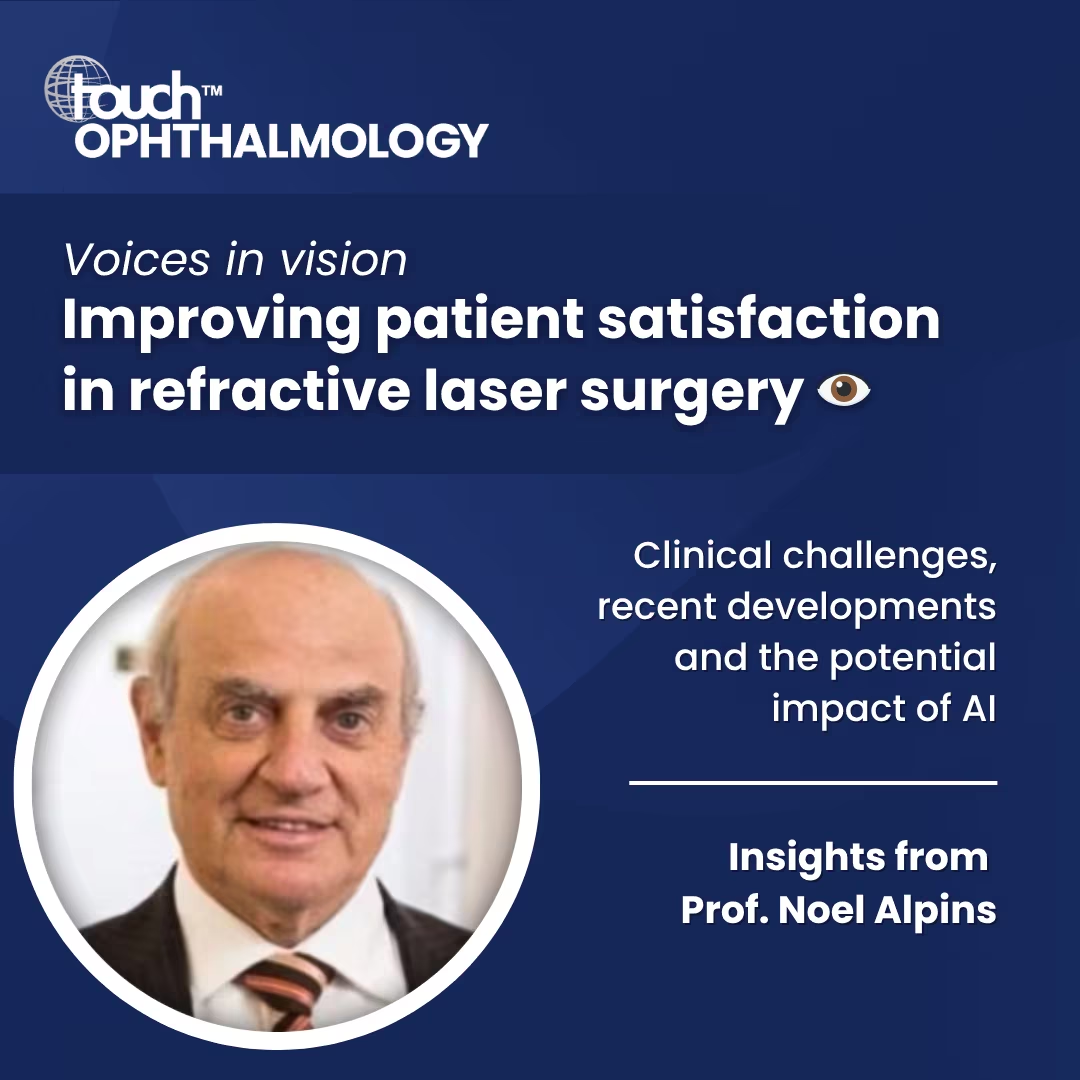
In this article we hear from Prof. Noel Alpins, a nationally and internationally recognised leader in cataract and refractive surgery, and a world authority on myopia and astigmatism treatment with the excimer laser. Since introducing refractive surgery to Australia in the 1980s and founding NewVision Clinics in the 1990s, Prof. Alpins has treated over 40,000 patients with laser vision correction and continues to play a pioneering role in advancing the field.
In this Q&A, he reflects on today’s clinical challenges, recent developments and the potential impact of artificial intelligence on the future of eye care.
Public confidence in the safety and effectiveness of laser vision correction lags behind the results that are routinely achievable with current technology. As a result, procedure numbers remain stagnant. Explanations vary, often depending on geography or individual circumstances, but one consistently overlooked factor—present since the 1990s—is the excess corneal astigmatism left untreated in a substantial proportion of patients when refractive parameters alone guide treatment. This includes wavefront-guided procedures, where corneal astigmatism values are also omitted.
Refractive and corneal astigmatism often differ by 0.7–0.8D, as quantified by ocular residual astigmatism (ORA) in otherwise healthy eyes. Yet ORA is rarely calculated preoperatively as a prognostic or screening parameter. When it exceeds 1.00D, as it can in up to a reported 40% of patients then this threshold becomes a predictable and avoidable “refractive surprise,” often inducing dysphotopsia symptoms of glare, starbursts or haloes (GASH).¹²
Although the free ASSORT® calculators (available on isrs.online, isrs.org and assort.com) for ORA and vector planning have increased substantially in their frequency of use over the near 10 years of availability (now averaging almost 100 calculations per week), but the concept of vector planning has not been widely accepted, even though independent prospective studies have confirmed their benefit.³⁴ Given the adage that it takes nine happy patients to counterbalance one unhappy one, it is unsurprising that 5% of patients with GASH symptoms can deter 45% of potential candidates, effectively halving the number of patients considering LVC. Reducing targeted corneal astigmatism by 40% or more using Vector Planning could bring almost all patients below the 1.00D threshold, thereby minimising dysphotopsias frequently highlighted on social media.
As corneal refractive surgeons, whether performing PRK, LASIK or SMILE/KLEx), we must factor in both corneal and refractive astigmatism during planning to minimise the risk of postoperative symptoms. Yet there remains a kind of blind faith in optical science paradigms that rely exclusively on manifest or wavefront refractive parameters, excluding corneal astigmatism values from the planning process. This approach inevitably maximises residual ORA, and consequently maximise the number of patients who might suffer dysphotopsias post surgery and advertise their dissatisfaction in various modes of communication.
Nearly 30 years after vector planning became available to address this issue, widespread adoption is still lacking. Until ORA becomes a routine preoperative assessment for LVC candidacy and the need for vector planning is recognised, we will continue to see an undercurrent of dissatisfied patients. This will continue to hold back the wave of patients’ demand we have been expecting at this late stage of the evolutionary cycle of the now mature laser technology.
The introduction of femtosecond technology for correction of myopia and astigmatism by KLEx, together with the ability of femtosecond technology to stabilise keratoconus with CAIRS In addition, ICL technology has improved with reduced risks such as early onset cataracts and IOP spikes, and can therefore be offered with confidence to patients who may not be suitable for refractive laser surgery.
The ability to gauge so much data very quickly. In refractive surgery, improving patient selection through data analysis—such as identifying patients at risk of developing keratoconus, and using AI algorithms to better predict procedural outcomes. Furthermore, improving accuracy of IOL selection and reducing refractive surprises after cataract surgery.
Analyse astigmatic outcomes using both corneal and refractive parameters. The corneal analysis of astigmatism will present an objective device-driven parameter, while the refractive analysis will be subjective with the target being a known at zero cylinder. Both should be considered when adjusting astigmatism nomograms to improve outcomes with future refractive laser procedures.
References
- Frings A, Katz T, Steinberg J, Druchkiv V, Richard G, Linke SJ. Ocular residual astigmatism: effects of demographic and ocular parameters in myopic laser in situ keratomileusis. J Cataract Refract Surg. 2014;40:232-8. doi: 10.1016/j.jcrs.2013.11.015.
- Su Q, Liang S, Cao H, Shan M, Wang Y. Effects of ocular residual astigmatism on refractive outcomes for myopia correction after keratorefractive lenticule extraction surgery. J Refract Surg. 2024;40:e966-e973. doi: 10.3928/1081597X-20241016-02.
- Jun I, Kang S, Arba Mosquera S, et al. Comparison of clinical outcomes between Vector Planning and manifest refraction planning in small incision lenticule extraction for myopic astigmatism. J Cataract Refract Surg. 2020;46:1149-58
- Arbelaez MC, Alpins N, Verma S, Stamatelatos G, Arbelaez JG, Arba-Mosquera S. Clinical outcomes of laser in situ keratomileusis with an aberration-neutral profile centered on the corneal vertex comparing vector planning with manifest refraction planning for the treatment of myopic astigmatism. J Cataract Refract Surg. 2017;43:1504-1514. doi: 10.1016/j.jcrs.2017.07.039.
Disclosures: Prof. Alpins has nothing to disclose in relation to this article. No fees or funding were associated with this article.
Citation: Noel Alpins. Voices in vision: Prof. Noel Alpins on improving patient satisfaction in refractive laser surgery. touchOPHTHALMOLOGY.com. 8 October 2025.
Register now to receive the touchOPHTHALMOLOGY newsletter!
Don’t miss out on hearing about our latest peer reviewed articles, expert opinions, conference news, podcasts and more.